
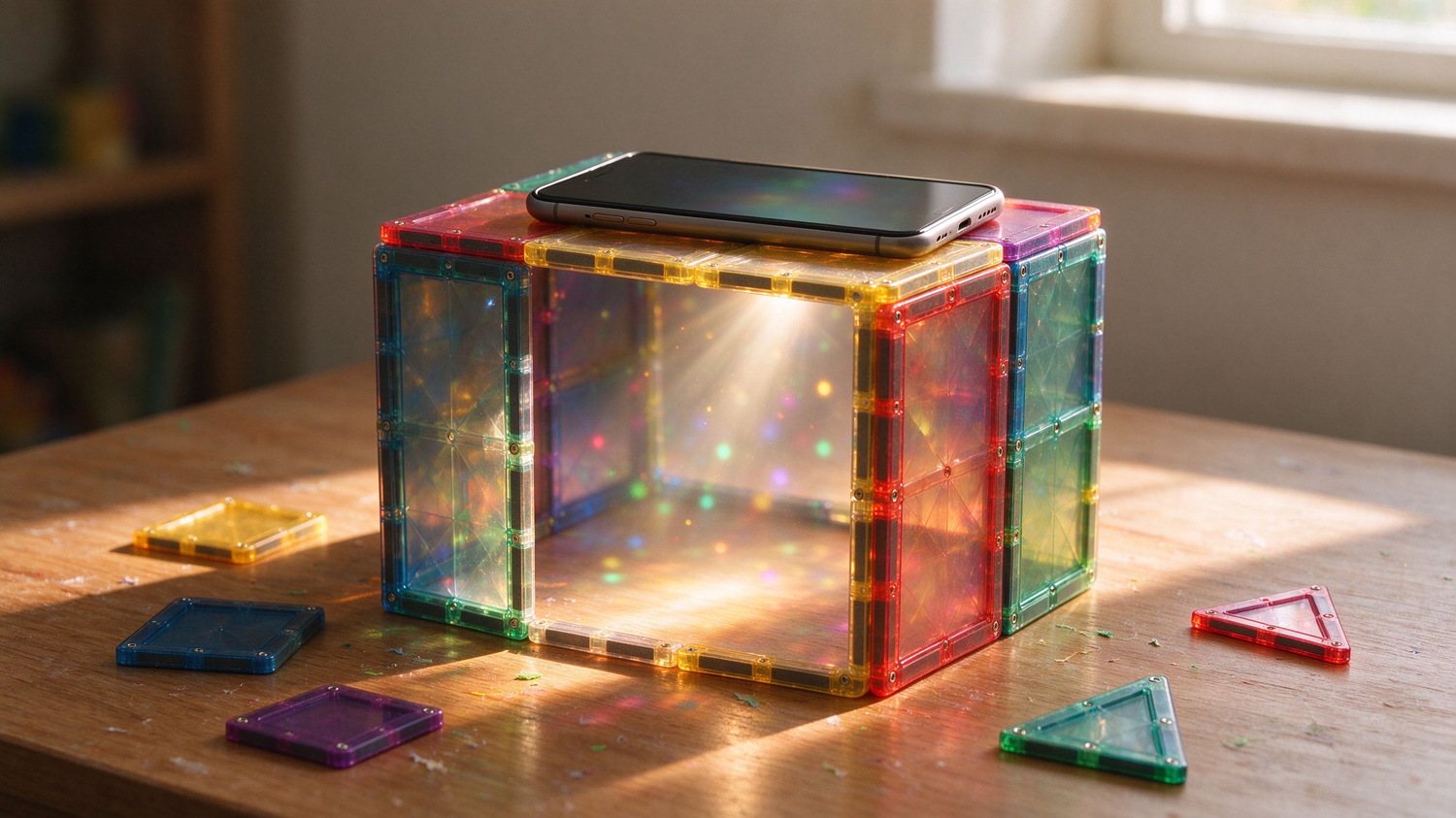
In early 2026, a DIY hologram trick built from magnetic tiles spread across short-form video platforms. The setup requires three square tiles in a row, four square tiles forming a box on the center tile, and two right-angle triangles flanking the box; a phone playing a hologram video is placed face-down on top, and a floating image appears inside the tile enclosure. The hack was not a manufacturer campaign. It was a user-generated reinterpretation of a construction toy as a stage for an optical effect.
The commercial context around this kind of content is measurable. On a leading short-video platform, the building-block toy category
saw year-over-year sales growth of 50.4 percent over a recent twelve-month period, with short-video commerce accounting for more than 90 percent of sales, and magnetic building and STEM-education products concentrated among the top performers. Search interest for magnetic tile sets has also shown sustained elevation, with average monthly searches reaching 540,000 and growth of 212 percent over a twelve-month window.
For toy brands and independent retailers, the hologram hack is less a trick to copy than a content template to learn from. It demonstrates that a magnetic tile set can function as a prop in a story that is not about construction. The product does not have to be the subject; it can be the apparatus. A brand that publishes a small library of open-ended uses, light and shadow play, tabletop challenges, parent-child build prompts, positions its tiles as the raw material for experiences rather than a finished toy with a fixed instruction. In a discovery environment where short video drives purchase, the brands that supply the content idea along with the product are the ones that get carried by the user's own sharing behavior.
Post time: Nov-04-2026


